
It's Not (Just) Perimenopause — It Might Be Your Metabolism?
What every woman in her 40s needs to know about their Metabolic Health!
The Chiron Return & Perimenopause sh*t sandwich.
Something I’m hearing a lot about lately, and talking with my girlfriends about constantly is our changing bodies. Our changing mood, changing tolerance levels, energy levels, anger levels, sleep patterns. Ev-ery-thing feels like it’s changing, and all the things that we use to do that worked, no longer work! It bloody sucks. Big time!
It’s relentless. Like most of the lovely ladies I speak with in their late 40’s, I went through several dark confusing, hard and exhausting years where I felt like I was falling apart physically, emotionally and mentally with every possible symptom you could imagine! Then I found a fantastic women’s health specialist who took all my symptoms and concerns seriously and put the idea of perimenopause into my head (that’s a whole other story) — it’s been a journey, but with knowledge, execution, experimentation and time, I’m feel like a functioning human again. The future is looking bright ladies!
But still, the deeper I go, and the more I study and learn about women’s health, particularly for those closer to 50 than 40 (and beyond) it’s not all just about our hormones. There I said it — feels blasphemous to say in this era of glorified hormone dysfunction.
Like many of you. I used to think I just needed to try harder. Fix myself.
Eat less. Sleep more. Stress less. Exercise more intensely. Take more supplements and herbal concoctions. The usual advice women in their 40s are given when they show up to a doctor’s office feeling like a stranger in their own body.
What nobody told me — what I had to piece together myself through research and the right experts — is that what I was experiencing wasn’t just perimenopause. It wasn’t just “getting older.” And it certainly wasn’t all just in my head.
It was also my metabolism. And once I understood that, everything changed.
First Things First: What Actually Is Metabolic Health?
“Metabolic Health” is one of those phrases that gets thrown around a lot without anyone stopping to explain it.
Your metabolism, simply put, is how your body converts food into energy. Every single cell in your body — your brain cells, your heart cells, your muscle cells — runs on energy. Metabolism is the system that makes that energy available. When it works well, you feel alive: clear-headed, energised, resilient, focussed, maintaining a healthy weight and ultimately feel….well!
When it doesn’t work well? That’s where things get interesting — and where so many women in their 40s find themselves.
Metabolic health is formally measured through five key biomarkers:
blood sugar (glucose)
triglycerides
HDL cholesterol (”good” cholesterol)
blood pressure
waist circumference.
True metabolic health means all five are in a healthy range — without medication.
Here’s the reality: research by Dr. Casey Means, Stanford-trained physician and author of the #1 NYT bestseller Good Energy, found that only 6.8% of Americans are fully metabolically healthy. Not unhealthy in an obvious, diagnosable way — just quietly, chronically not functioning at their best.
And women in their 40s? We are disproportionately affected. Here’s why.
The Missing Conversation: Hormones Are Metabolic Regulators
This is the piece that most women — and honestly, most GPs — have never been taught.
Estrogen is not just a reproductive hormone. It is a metabolic protector.
As Dr. Mindy Pelz, functional medicine expert and author of Fast Like a Girl, explains: estrogen permeates every organ in the body during our reproductive years, keeping us both fertile and metabolically healthy. It helps our cells respond to insulin, supports mitochondrial function (our cellular energy factories), and keeps inflammation in check.
When estrogen begins to decline — which starts happening as early as our mid-to-late 30s, well before any classic perimenopause symptoms appear — the body’s metabolic machinery starts to shift. Cells become less responsive to insulin. Fat storage patterns change (hello, belly fat that didn’t used to be there). Energy production becomes less efficient.
Meanwhile, declining progesterone — the other key female hormone — removes what was essentially a built-in calorie-burning mechanism. During a healthy cycle, the luteal phase (the second half of your cycle) burns an extra ~50 calories per day for 12–14 days. That’s around 600–700 calories a month that simply disappear when your cycle becomes irregular or stops. Small individually, significant over time.
And then there’s cortisol — the stress hormone that, for women in peak “sandwich generation” years (juggling careers, children, ageing parents, relationships), is often chronically elevated. Dr. Sara Gottfried, Harvard/MIT-trained physician and author of The Hormone Cure, is clear that cortisol is the master hormone — when it’s dysregulated, everything else follows. It raises blood sugar, promotes fat storage, disrupts sleep, and creates a cascade of symptoms that look, feel, and test remarkably like perimenopause.
The Misdiagnosis Problem Nobody Is Talking About
A 2025 national survey found that nearly 40% of women felt they were misdiagnosed when seeking care for perimenopause symptoms — many receiving prescriptions for anxiety and depression medications while the underlying hormonal or metabolic root cause went entirely unaddressed.
But the flip side is equally true and far less discussed: many women who believe they are experiencing perimenopause are actually experiencing the symptoms of metabolic stress — or a combination of both, deeply intertwined.
“Is it hormones… or is it metabolic stress?”…..
Look at this symptom overlap:
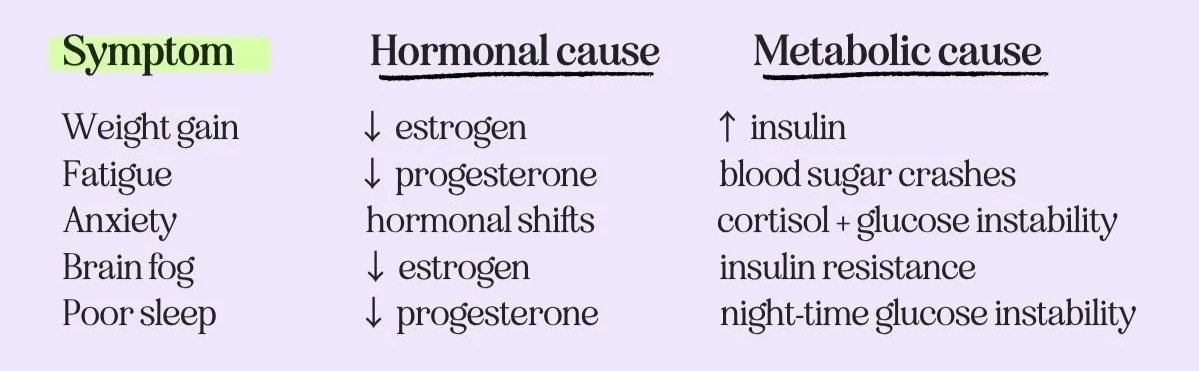
The research is striking: women with insulin resistance and blood sugar dysregulation experience worse hot flashes. Women with hot flashes have a significantly higher risk of developing Type 2 diabetes. These two things are not separate conversations — they are deeply linked biological events.
And critically: researchers note that many symptoms commonly attributed to perimenopause — fatigue, weight change, irritability, sexual dysfunction — can in fact point to a carbohydrate metabolism disorder, not a hormonal one. The conditions can look almost identical on the surface.
The Real Villain: Insulin Resistance
Like most of you, I’d honestly never heard the term insulin resistance until I was about 45yrs old! I knew about Insulin. No interest, what-so-ever. But, if there is one concept to take away from this article, it’s this.
Insulin resistance is the slow, silent process by which your cells gradually stop responding to insulin’s signal. Over years of blood sugar spikes from processed food, chronic stress, poor sleep, and a sedentary lifestyle, your cells essentially go numb to insulin. Your body compensates by pumping out more and more of it.
The consequence? Sky-high insulin levels that lock your body into fat-storage mode, make weight loss nearly impossible, fuel inflammation, disrupt sleep, cloud your thinking, disrupt brain signaling (appetite, mood) and — you guessed it — mimic perimenopause almost perfectly.
Here’s the thing that changes everything: insulin resistance can precede elevated blood sugar by a decade or more. You can have normal fasting glucose on a standard blood test and still have significant insulin resistance driving your symptoms. Standard medicine isn’t testing for it. Your symptoms are real, the test just isn’t sensitive enough to catch what’s causing them.
Dr. Casey Means describes it this way: when estrogen drops, the cells lose one of their key allies in staying insulin-sensitive. Women who were previously metabolically resilient can suddenly find themselves in a state of insulin resistance — and the symptoms that follow are almost indistinguishable from perimenopause.
Some red flags that it might be metabolic, and not just hormones.
Belly fat that appeared “overnight”
Energy crashes after meals
Constant sugar / carb cravings
Waking at 2–4am
Feeling “wired but tired”
Increasing cholesterol or glucose markers
Exercising more but gaining weight
These are classic insulin + cortisol dysregulation signs
What You Can Actually Do — The Empowering Part
This is where the research from functional medicine gets practical. You are not powerless here. Not even close.
1. Eat to stabilise blood sugar — not just to eat less
Forget calorie restriction. Research consistently shows it doesn’t work long-term for women with hormonal imbalances. Instead, focus on when and what you eat:
Eat balance meals (protein + fat + ‘non-naked’ carbs) BUT prioritise protein and fibre at every meal to slow glucose release. Aim for 25–35g protein per meal.
Eat your biggest meals earlier in the day when insulin sensitivity is naturally higher. Eat within 1–2 hours of waking
Reduce ultra-processed foods and refined carbohydrates — not because calories, but because blood sugar spikes drive insulin, which drives fat storage and inflammation
Consider meal sequencing: eating vegetables and protein before carbohydrates flattens your blood sugar response.
2. Explore fasting — strategically, as a woman
Dr. Mindy Pelz’s core message is that women cannot simply adopt male fasting protocols. Our hormones require a more nuanced approach. For women in perimenopause, a gentle starting point is a 12–13 hour overnight fast (e.g., finish dinner by 7pm, eat breakfast at 7–8am). This alone can meaningfully improve insulin sensitivity and reduce inflammation without placing excessive stress on the body.
For those wanting to go further, the 5-1-1 framework (five days with a comfortable eating window, one day more restricted, one day no fast at all) can support both metabolic health and hormonal balance.
3. Move differently — less cardio, more strength
This is the exercise shift that most women in their 40s need to hear. Chronic cardio (long runs, endless spin classes) can actually elevate cortisol in perimenopausal women, worsening the very hormonal imbalance they’re trying to address. Muscle is your metabolic superpower — it acts as the body’s primary glucose disposal system, drawing blood sugar out of circulation independently of insulin. Dr. Mariza Snyder puts it simply: lifting weights and maintaining muscle mass is your metabolic sync. Aim for resistance training 2–4x/week
Less muscle =
- poorer blood sugar control
- more insulin resistance
- more fat gain (especially visceral)
Add short walks after meals — even 10 minutes dramatically blunts post-meal blood sugar spikes — and aim to break prolonged sitting with brief movement throughout your day.
4. Treat sleep as medicine
Poor sleep isn’t just a symptom of metabolic dysfunction — it’s a cause of it. Sleep = metabolic reset! One bad night raises cortisol, dysregulates blood sugar, and increases hunger hormones. Prioritise 7–9 hours, reduce blue light exposure in the evening, and eat your last meal at least 2–3 hours before bed.
5. Test — and test the right things
This is perhaps the most empowering step of all: knowing your actual numbers. Ask your doctor (or seek a functional medicine practitioner if needed) for:
Fasting insulin — the single most important marker most women have never had tested
Fasting glucose and HbA1c — blood sugar trend data
Triglycerides and HDL — early metabolic dysfunction markers
High-sensitivity CRP (hs-CRP) — inflammation marker
Full sex hormone panel: estradiol, progesterone, testosterone, DHEA-S
Full thyroid panel: TSH, Free T3, Free T4 (thyroid dysfunction mimics both metabolic and perimenopause symptoms almost exactly)
Cortisol (ideally a 4-point test across the day, not just a one-time blood draw)
Knowledge is not anxiety — it is power. The earlier you have this data, the more agency you have.
The Bottom Line
You are not imagining it. You are not weak of falling apart. You are not simply ageing.
What you may be experiencing is a collision of hormonal change and metabolic stress — two forces that amplify each other and are almost impossible to tell apart without the right information and the right tests.
The good news? Both are addressable. Not with willpower, not with deprivation, and not with yet another prescription that masks the symptoms without treating the cause.
It starts with understanding what’s actually happening in your body. And it starts with refusing to accept “this is just perimenopause” as the end of the conversation.
Your body is communicating with you. It’s time we learn to listen.
Want to go deeper? The experts I trust most on this topic: Kitty Bloomfield, Dr. Mindy Pelz (start with Menopause Reset of Fast Like a Girl*), Dr. Casey Means (Good Energy), Dr. Sara Gottfried (The Hormone Cure), Dr. Ben Bikman (Why We Get Sick), and Dr. Jason Fung (The Obesity Code). These books changed how I think about my health — and they’ll change how you think about yours too.*
These are the glory days. Embrace the metamorphosis.